Obsession: The Woman Behind the Smile
Bear wished for the woman he loved to love him back. Scary Bacon looks at the person trapped inside that wish.
⚠ Contains spoilers
There’s a version of Obsession where Bear is the victim of a relationship gone horribly wrong.
You can see how someone gets there. He’s lonely. He wants to be loved. He makes a wish that Nikki will feel about him the way he feels about her, and then he gets the girlfriend of his dreams.
For about five minutes.
What follows is painful, uncomfortable, and increasingly difficult to watch. Nikki becomes possessive and unpredictable. The relationship spirals into something grotesque. At a certain point, you might find yourself thinking, “Man, this poor guy. He just wanted a girlfriend.”
And then it occurs to you:
So did Nikki. She wanted the freedom to decide whether Bear was someone she wanted to be with.
She doesn’t get it.
Be careful what you wish for
Curry Barker’s Obsession is a nasty little wish-gone-wrong story, but it’s also a movie about what can happen when one person’s desire becomes more important than another person’s humanity.
Bear, played by Michael Johnston, doesn’t begin as some obvious villain. He’s awkward and lonely. He’s in love with Nikki, played by Inde Navarrette, and he wants her to love him back. That’s understandable. Most of us know what it feels like to want someone who doesn’t want us in the same way.
The wish is where things change.
Bear gets the answer he wants, but Nikki doesn’t get to give it. Her feelings, her choices, her body: everything that makes a relationship hers, too, is pulled into the service of his desire.
And at first, he can enjoy it. Nikki is suddenly attentive, affectionate, available. She wants him. He’s wanted this for so long that he can overlook the parts that don’t feel quite right.
Until he can’t.
There’s something ugly and painfully human in that. How much are we willing to ignore when we’re finally getting the thing we’ve convinced ourselves we need?
The woman inside
The real horror of Obsession, for me, isn’t that Nikki becomes the girlfriend from hell.
It’s that the real Nikki is still there.
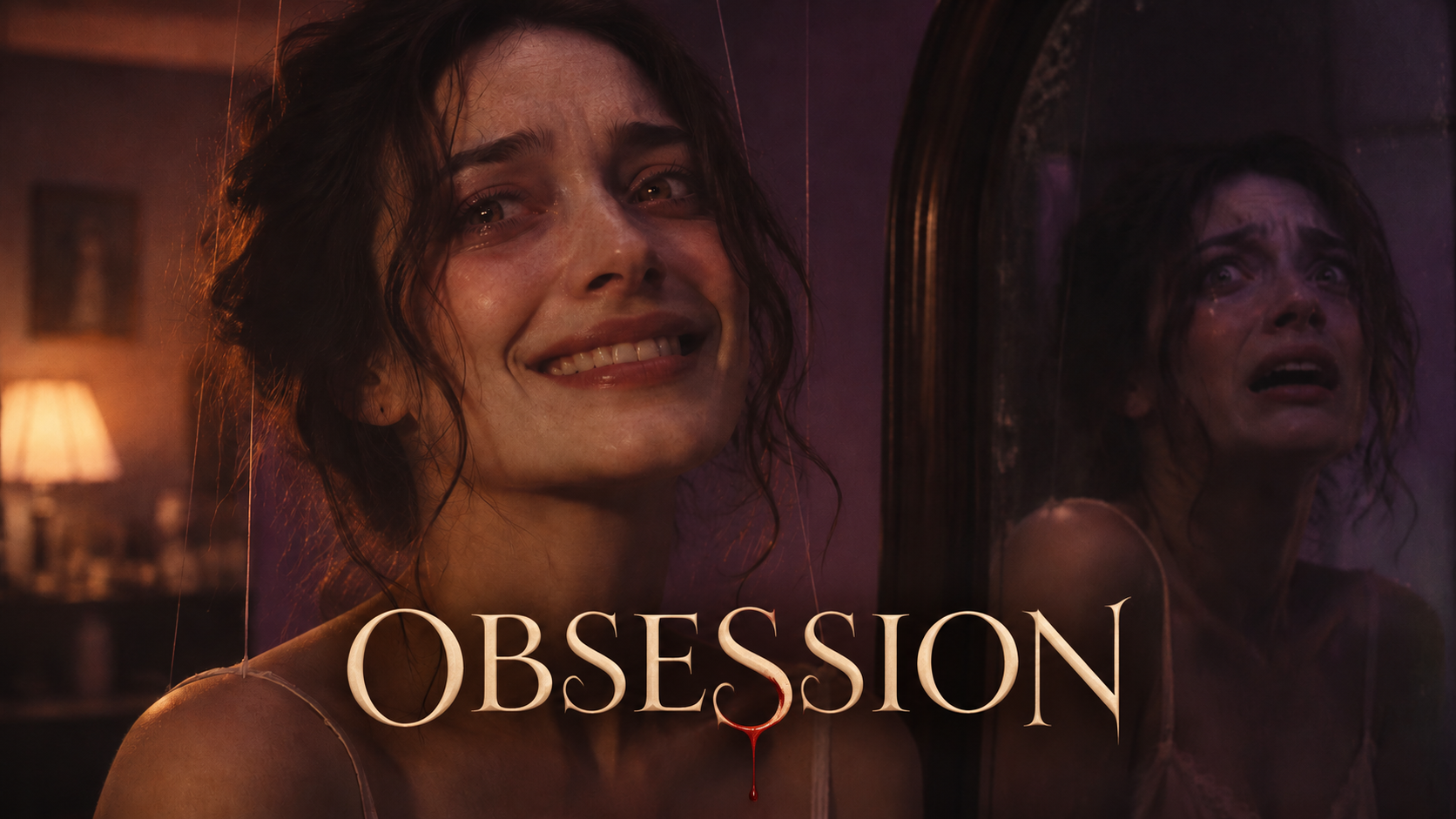
She isn’t simply transformed into another person. Her consciousness is trapped while something else uses her body. She’s aware of what’s happening. Aware of what she’s doing. Aware that her body is saying yes to a life she never chose.
Imagine that for a moment.
You’re in the room. You can see the person in front of you. You know what’s happening, and you know it’s wrong, but you can’t make your body stop. You can’t make your voice say what you mean. And when you manage to break through, even for a second, you’re dragged back under.
Navarrette is extraordinary in those moments. The flashes of fear make the rest of Nikki’s behavior harder to dismiss as simply unhinged. There’s a person behind the smile, and she is fighting to get out.
That’s where the film edges into body horror. We often think of body horror as the body changing into something monstrous. Here, the terror is in the separation between what Nikki knows and what her body is made to do.
Her own body becomes the place where she is held captive.
The girlfriend he ordered
I don’t know whether Barker intended Obsession as a direct commentary on the MAGA-bro culture we’re living in. But I can’t watch this movie without seeing that connection.
We’re surrounded by voices telling men that women are the problem. That women have become too demanding, too independent, too unwilling to fit into the roles men have decided they should occupy. And that somewhere out there is a version of masculinity that can put everything back where it supposedly belongs.
It shows up in politics. In podcasts. In the endless parade of social media guys explaining what women really want, usually while sitting in front of a microphone that cost more than my first car.
What they’re selling is often dressed up as confidence or tradition or the search for love. But underneath it, there’s frequently a fantasy of control: a woman who will want what he wants, affirm who he is, and never complicate the story he tells himself.
Bear’s wish makes that fantasy literal.
And the cost isn’t just that the relationship becomes dysfunctional. The cost is Nikki’s agency. Her ability to say no. Her ability to know what she wants and act on it.
There’s an existential violence to that. If your thoughts are still your own but your choices aren’t, where do you go? What’s left of you that the world can see?
Who gets to be afraid?
What complicates the film, and makes it worth talking about, is that it spends so much time with Bear’s fear. We watch him realize that the woman he wished for has become a threat to him.
But Nikki was in danger from the moment the wish came true.
I found myself wanting the movie to stay with her longer. To let us experience more of what it means to be trapped behind her own eyes. The film gives us glimpses, and those glimpses are devastating. But because we’re so often looking through Bear’s perspective, Nikki’s suffering risks becoming another frightening thing happening to him.
That may be the film’s limitation. It may also be part of what makes the conversation interesting. How easily do we accept the story of the man whose fantasy went wrong while overlooking the woman who never got a say in it?
Obsession is weird, brutal, and sometimes darkly funny. It’s a relationship nightmare, a supernatural cautionary tale, and a film that understands how quickly the desire to be loved can become something much uglier.
But the image I’m left with isn’t Bear getting more than he bargained for.
It’s Nikki, somewhere inside, trying to make herself heard.
What did you think about Obsession?
Your reaction is saved on this device.