KRAKEN: The Monster We Woke Up...Again
I watched *Kraken* on a plane. Good airplane movie. Beautiful fjord, enormous tentacles. But the thing I kept thinking about after we landed was the fish farm. The monster had been down there all along. It took a business plan to wake it up.
Kraken: The Monster We Woke Up
I watched Kraken on an airplane, which feels like the appropriate place to confess this:
It’s not a great movie.
It is, however, a good airplane movie. Beautiful scenery, an enormous creature, people making questionable decisions near water. There are worse ways to spend a few hours while a stranger’s elbow negotiates for control of your armrest.
But somewhere between the fjords and the flying tentacles, the movie started to stick with me.
Because I’m not sure the Kraken is the thing we should be most afraid of.
Something in the water
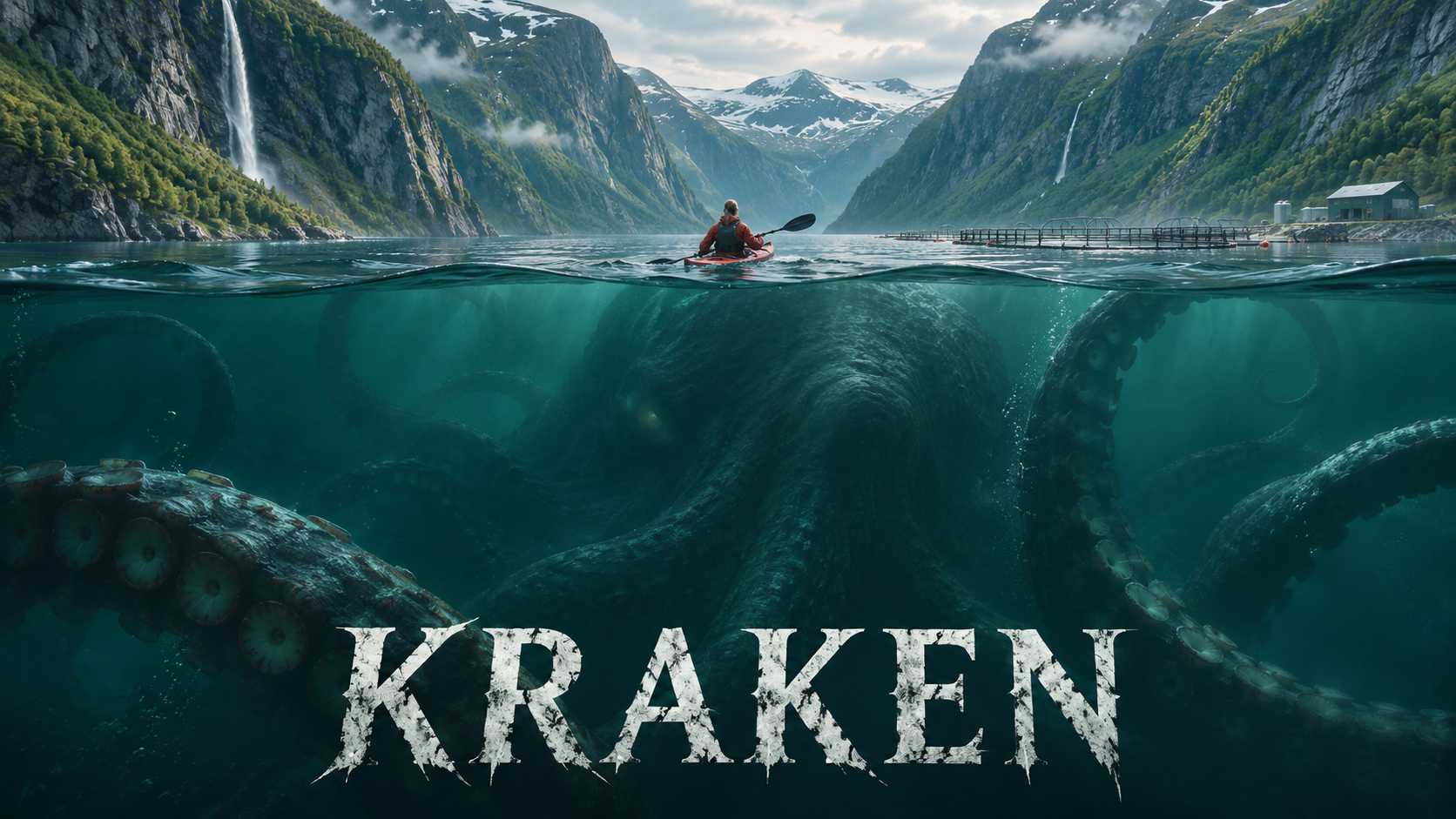
On the surface, Pål Øie’s Kraken is a creature feature. A marine biologist named Johanne, played by Sara Khorami, returns to a community along Norway’s Sognefjord after something strange begins happening to the salmon. Fish are turning up where they shouldn’t, people are dying, and the water that has sustained the community for generations is becoming a place of fear.
And, yes, there’s a Kraken.
A big one.
The sort of thing that makes you reconsider that kayaking trip you booked because the brochure used words like peaceful and scenic.
You could easily put the film in the Lovecraftian or cosmic horror category. There’s an ancient creature beneath the water, something immense enough to make the people above it feel very small. The fjord is beautiful, but its beauty conceals a depth we can’t see and a life we don’t understand.
But cosmic horror often asks us to consider our insignificance in a universe that doesn’t care about us.
Kraken seems more interested in what happens when we act as if the world beneath us doesn’t matter.
The bottom line
At the center of the story is a fish farm using sonic technology to deal with parasites. The technology promises a solution to a problem, and a profitable one at that. There’s interest from investors. There’s an opportunity to grow.
And there are consequences in the water.
The people involved don’t set out to awaken an ancient sea monster. As far as business plans go, “release the Kraken” probably isn’t on the first slide. But the technology disturbs an ecosystem that is more complicated than the people selling the solution appear willing to acknowledge.
That’s where the film becomes more interesting to me.
The creature isn’t awakened because someone spoke an ancient curse. It’s awakened because people developed something, put it into the water, and failed to understand or reckon with what it might do.
The bottom line becomes more dangerous than what lies at the bottom.
I don’t think Kraken is especially subtle about corporate greed. The wealthy people are interested in money, the warning signs are inconvenient, and the monster gets progressively less interested in respecting anyone’s quarterly projections.
But subtlety isn’t always the point of a monster movie. Sometimes you need a giant tentacle to drag the metaphor directly into the boat.
When a community becomes a product
What I found more compelling than the corporate villains was the community caught between what the fjord has been and what it is becoming.
This is a place shaped by water. The fjord isn’t just a pretty background or an untapped resource. It’s where people work, where families have built lives, where local knowledge and stories have accumulated over generations.
Then the fish farm becomes part of a larger economic machine. New technology promises efficiency. Investment promises opportunity. Decisions made for growth begin to affect the water, the fish, and the people who live beside both.
That tension feels familiar, even if you’ve never set foot in Norway.
A town needs jobs. People need to pay their bills. A business arrives with money, technology, and a plan for the future. It can be difficult to argue with a plan that promises work, especially when the alternatives are leaving home or watching your community slowly disappear.
But what happens when the economic future being offered begins to damage the very thing the community depends on?
And who gets to decide that the damage is acceptable?
The people who live there have to keep living with the answer long after an investor has gone home.
The stories we stop hearing
There’s also a generational tension running underneath this. The older stories about what lives in the fjord sit beside a younger generation growing up in a community being reshaped by technology and corporate interests.
I’m interested in what happens when a place’s mythology starts to feel like something from another time. The stories are still there, but they no longer seem connected to the systems making decisions about the water today.
Maybe the old stories were never just about monsters.
Maybe they were a way of saying: Pay attention to this place. There are things here you don’t understand. Your actions have consequences, and the water does not belong to you simply because you found a way to profit from it.
Of course, in Kraken, there’s also an actual monster. So the elders may have been considerably more literal than the rest of us were prepared to appreciate.
Still, the divide matters. When a community loses its connection to the stories it tells about itself, what replaces them? Who gets to define what the place is for?
The people who live there? The people who remember it? Or the people who see an opportunity to scale it?
What are we waking up?
The technology in Kraken is designed to solve a specific problem, but its potential reaches far beyond one fish farm. That’s part of the promise: build a solution that works here, and perhaps you can take it somewhere else. And somewhere else after that.
But if you can scale a technology, you can also scale its unintended consequences.
That doesn’t mean technology is the monster. It means our confidence in what a technology can do sometimes moves faster than our understanding of what else it might do.
We release things into complex systems all the time. Markets. Communities. Information networks. Ecosystems. We look for the immediate benefit, the competitive advantage, the return. Sometimes we notice the damage only after it starts washing up on shore.
And by then, the thing moving beneath the surface may be bigger than we expected.
I wonder what a horror movie about the pollution of democracy through corruption would summon.
A monster? A slasher? A politician?
Maybe all three. The politician would probably insist the monster was great for jobs.
What lies beneath
I don’t think Kraken explores all of these ideas as deeply as it could. The characters and corporate conflict sometimes feel more like familiar pieces of a creature feature than the beginning of a fully developed conversation about a community under pressure.
I wanted more of that community. More of the people trying to hold on to a way of life while the water, the economy, and the stories they inherited changed around them.
But I’m still thinking about it. For a movie I watched between the beverage cart and the captain announcing our descent, that’s saying something.
The Kraken is what lies beneath the surface of the fjord. It’s ancient, enormous, and more than capable of ruining your afternoon.
But what lies beneath the surface of private profiteering is a different kind of terror: the belief that we can keep taking, keep building, keep disturbing what we don’t understand, and leave someone else to deal with whatever wakes up.
In this movie, it has tentacles.
I’m not sure it always will.
What did you think?
Your reaction is saved on this device.