Buddy and the Things That Steal Our Childhood
What happens when the friendly face on the screen becomes something more? Scary Bacon takes a closer look at the horror hiding inside childhood.
⚠ Contains spoilers
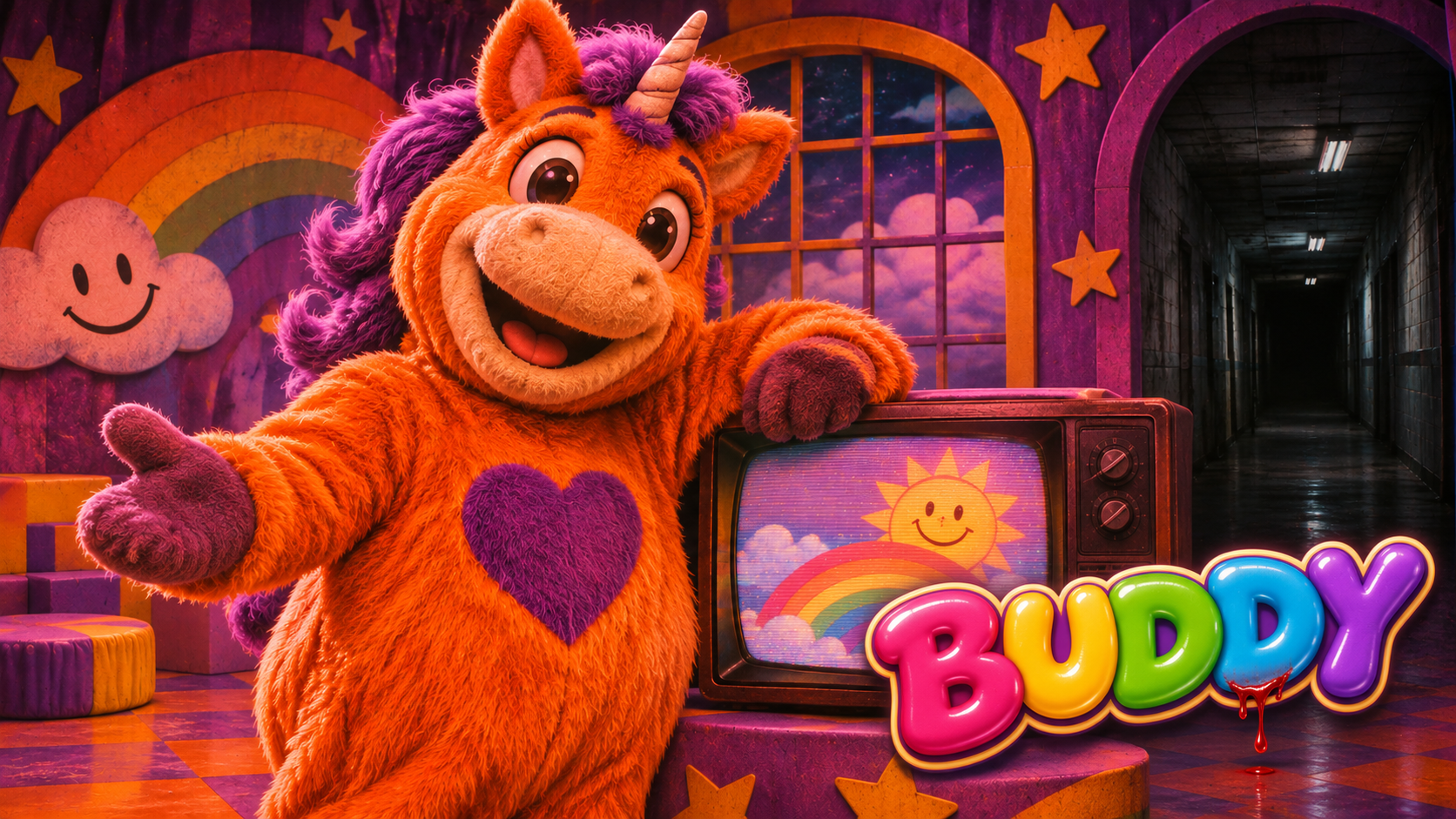
There’s something deeply unsettling about a giant orange unicorn who wants to be your friend.
Maybe it’s the permanent smile. Maybe it’s the voice that never drops below a cheerful sing-song. Maybe it’s the fact that he seems a little too interested in making sure you’re happy.
Or maybe it’s that, somewhere underneath all that orange fur, Buddy knows something the children don’t.
They’re his.
Casper Kelly’s Buddy starts in a place that feels familiar: a brightly colored children’s television show where a friendly creature teaches lessons, leads songs, and surrounds himself with smiling kids. If you grew up with Barney, or raised kids who did, you know the neighborhood.
At first, the joke seems obvious. What if Barney was a killer?
And, to be fair, that’s a pretty good place to start. But I don’t think that’s where the movie ends.
The more I think about Buddy, the more I think it’s a movie about the loss of childhood. About the things that reach into a child’s world, make themselves comfortable, and begin shaping who that child becomes.
Some of those things are violent.
Some of them come with a catchy theme song.
A friend who decides what friendship means
Buddy’s world looks like a place built for children. There are songs, lessons, colors, and the promise that everything will be okay as long as everyone plays along.
But the longer we spend there, the more uncomfortable that promise becomes. The children are expected to be happy on cue. To accept Buddy’s version of events. To trust that he knows what’s best.
And when they don’t?
Well. Buddy has some feelings about that.
The film understands something about children’s television: the characters often speak directly to the child. They ask questions. They wait for an answer. They offer reassurance. They behave, in many ways, like a friend.
I don’t think there’s anything inherently sinister about that. My kids watched television. I watched television. A lot of us learned things from the people and puppets who showed up in our living rooms.
But Buddy takes that intimacy and follows it somewhere dark. What happens when the friendly figure on the screen becomes an authority? When their idea of a good child is a child who stays where they’re told, says what they’re supposed to say, and doesn’t ask too many questions?
Freddy, played by Delaney Quinn, begins to notice the cracks. She’s surrounded by a world that insists everything is fine while the evidence keeps suggesting otherwise.
That’s a lonely place to be, especially when you’re a kid.
Quinn gives Freddy enough curiosity and fear to make her feel like a child trying to understand an impossible situation, rather than a tiny adult waiting to deliver a clever line. And Keegan-Michael Key’s voice work gives Buddy that awful combination of warmth and control. He can sound like your best friend right up until the moment you disappoint him.
Which, honestly, may be the scariest thing about him.
Raised by the screen
There’s another part of Buddy that stayed with me: the idea of parents losing their children to something they may not fully understand.
Grace, played by Cristin Milioti, has a sense that someone is missing from her family. She can’t easily explain it. She’s trying to find a child the world around her doesn’t seem to remember.
That’s a hell of a horror premise on its own. But as a metaphor, it reaches into something a lot of parents probably recognize.
There are times when you look at your child and realize that an entire world has formed around them while you were doing your best to keep up. They have references you don’t know, voices they listen to, people they trust, jokes you don’t get. Some of that is healthy. They’re becoming themselves, and they need a world that isn’t entirely yours.
But who else is in that world?
When I say “TV parenting,” I’m not talking about some moral panic over a cartoon or a tired parent turning on a show so they can make dinner. Parenting is hard enough without pretending every screen is a portal to hell. If that were true, a lot of us would need to have a very uncomfortable conversation with the Bluey family.
I’m thinking about the cumulative effect of handing so much time and attention to systems we didn’t create, often without knowing exactly what those systems are teaching.
Not just the stated lesson. The other lessons.
What does a child learn about beauty from what they watch? About happiness? About what makes a person worthy of attention? About what they need to own before they can belong?
And what happens when the things answering those questions have something to sell?
Buddy doesn’t need to be read as a literal indictment of children’s advertising to make that connection. For me, it opens the door. Behind the friendly character is a structure that wants the child’s attention and obedience. Our real-world structures are more complicated than Buddy’s clubhouse, but they aren’t always neutral.
Somebody chooses what appears on the screen. Somebody decides what holds a child’s attention. Somebody makes money when that attention stays put.
Buddy just makes the arrangement a little more visible.
And a lot more bloody.
Childhood, brought to you by…
One of the strangest things about childhood is how much of it arrives already packaged.
The toy connected to the show. The shirt connected to the toy. The birthday party connected to the character. The endless invitation to bring one more piece of that world home.
Again, I’m not pretending toys and stories are bad. I love this stuff. So do my kids. The connection between imagination and the things we collect can be joyful and meaningful.
But I do wonder how early we begin teaching children to experience desire as something that can be satisfied by the next thing.
That’s one reason Buddy put me in mind of Halloween III: Season of the Witch. Both films understand the power of a cheerful message delivered directly into the home. In Halloween III, the product itself is part of the threat. In Buddy, the friendly world is the trap.
Then there’s Poltergeist. Carol Anne sits in front of the television, drawn toward something her parents can’t see. The screen becomes a way for another world to reach into the house and take her.
The details are different, but the image is hard to shake: a child sitting in the supposed safety of home, talking to someone on the other side.
In all three films, the adults’ comfortable assumptions make the horror possible. The dangerous thing has already been welcomed inside.
Stephen King and the door we all walk through
Stephen King returns to childhood so often because he understands that children live close to things adults have learned to look away from.
Death. Cruelty. Shame. The knowledge that grown-ups are not nearly as powerful or dependable as they seemed when you were five.
In Stand by Me, the boys go looking for a dead body. On the surface, it’s an adventure. Underneath, it’s a journey toward an understanding they can’t undo. They encounter death, yes, but they also encounter the possibility that the world won’t make room for all of them in the same way.
And then, quietly, the friendships change. Time moves. The boys move with it.
That part gets me.
Because the loss of childhood isn’t always a single terrible event. Sometimes it’s gradual. One day you stop calling the friend you used to see every afternoon. One day the places that felt enormous are smaller than you remember. One day you realize your parents were people carrying their own fears and disappointments while you thought they had the answers.
In It, the children face a monster, but they also face a town full of adults who are unable or unwilling to see what’s happening. The kids have to trust one another because the people who should protect them keep looking away.
Buddy belongs in that conversation. Freddy begins to see what’s wrong. The world around her insists on the script.
But there’s a difference that makes Buddy particularly sad. In Stand by Me, the boys are moving toward the end of childhood, whether they know it or not. In Buddy, the children are trapped in a counterfeit version of it: a place where the games continue and the songs keep playing, but curiosity can get you killed.
They’re surrounded by the appearance of childhood while being denied the freedom to actually be children.
The cost of getting out
The movie isn’t perfect. Its first stretch is so committed to the look and rhythm of an old children’s program that the idea feels wonderfully nasty and specific. As the world opens up, the film has more to juggle: the mythology, the chase, Grace’s story, and the fate of the children. Some of that emotional territory could use more room to breathe.
I wanted more time with Grace and Freddy. More time to feel the weight of finding each other after so much had been taken from them.
But maybe that frustration is part of why the movie lingers for me. There’s an ache underneath the absurdity, and the film doesn’t always stop long enough to let us sit with it.
By the end, Freddy has made it out, but escape doesn’t put everything back the way it was. She arrives in the real world carrying experiences no child should have had to carry. And the family waiting on the other side doesn’t simply remember her because she’s found her way home.
That image hits harder than the orange unicorn.
Because what does it mean to return home after the world has changed you? What does it mean when you’re ready to be found, but the people who love you don’t recognize what’s happened?
I keep coming back to the idea that we talk about childhood as if it’s something we simply grow out of. And some of it, of course, we do. We grow. We learn. We discover things our younger selves couldn’t understand.
But some things are taken.
Time. Trust. A sense of safety. The freedom to explore a world before someone has decided what you should buy, who you should follow, or how you should behave.
Buddy wraps all of that in bright colors, silly songs, and an orange unicorn with a very bad temper. It’s funny, weird, and often pretty gruesome.
But beneath the fur, I think there’s a question worth sitting with:
When a child disappears into a world built for them, how long does it take the rest of us to notice?
What did you think?
Your reaction is saved on this device.